Friday, 17 October 2008

Hols in the UK

I should apologise for the lack of entries over the last month, but we have been away enjoying our annual leave, but now back in residence on Aride we have got chance to catch up. As part of our contract we get two months annual leave, one of the months comes together with a return flight to the UK, so all excited on the 12th September we found ourselves on Air Seychelles actually flying back to the UK for a holiday, at this point I realised I had never actually gone to the UK from another country for my holidays before.

A month sounds a long break and it was going to be the first time that Melv and I had actually ever taken a holiday for such a length of time and not been building a house or the like. But having said that, looking back now I can’t believe how quickly the time actually went.


We had a wonderful break; a large percent of it was spent staying with mum and dad on the North Wales coast, slightly different temperatures to the Indian Ocean that we were used to, but a fantastic coastline, with sandy bays and rugged cliffs and excellent walks. I managed to meet up with family, and Melv who was experiencing withdrawal symptoms from no fishing managed to buy the cheapest rod in the local shop and with the first cast bring out a 4 ½ Ib bass that was the talk of Rhos on Sea seafront.


We did manage to get to Spain to see friends Steve and Kate, for which our livers will never forgive us. Now living near Grenada, they have started a project restoring an old mill house in Bazza Natural Park and it was excellent to be able to explore a part of Spain that we have never been to before. A very quiet and beautiful part of the world, and on walking up the valley beside the house over a weekend we saw more golden eagles than people all day. Melv particularly enjoyed sampling the tapas, and I managed to take two dips in the Med – blinkin freezing after the Indian Ocean.


Towards the end of the month, our travels took us to Somerset for a very short stay, limited by this time by finances, but we managed to meet up with family and friends and of course went out to the local curry house. Melv put his liver through yet some more abuse, from which his mate took two days to sober up, whilst I managed to get a ukulele lesson over a bottle of wine or two.


There were loads of things we had hoped to do but never managed to, sorry Bob I never got to the AGM, but it was excellent to see the photos and sorry Von and Sarah; I never got to give you a call our time in Somerset was very brief.


Some of the other highlights of the month were to walk into a supermarket and just look at the fruit and vegetables then being able to fill our basket with whatever we wanted, especially bread, cheese and chocolate. To have a cup of builder’s tea with semi skimmed milk every morning, probably one of the simple things I’ve missed most! To go to the pub, where I had been dreaming of eating steak and ale pie and chips – and do so – hard to believe I used to be vegetarian. To watch footie on the TV, especially Liverpool beating Man Utd, sorry Melv, and drink beer.

We got back to Seychelles just a couple of days ago and it is good to be back, even though on our first shopping trip we were to be told that milk, milk powder, vege oil and cheese were ‘All finished’!

Thursday, 14 August 2008

'When I'm An Old Woman I Shall Wear Purple'

Purple hermits have obviously been inspired by this great little book, there is nothing quite like them here on Aride.

Follow this special sequence - this one moved home in a matter of seconds


Saturday, 9 August 2008

The Toktok

Toktok is the local name given to the Seychelles Fody, the closest species in character that we would have in the UK is probably the house sparrow. However believe it or not the toktok is even cheekier and probably one of the cheekiest species I have ever known. Endemic to the Seychelles, in 2000 there were under 3,000 birds left, particularly vulnerable to cats and rats the population has significantly declined. 65 birds were reintroduced on to Aride in February 2002, and are now doing very well, and are a very common sight around the houses and buildings. They have a loud little song, kind of like the British wren and they will give it full pelt especially if they are after something like food or in this case today a piece of the office sweeping brush.

The sweeping brushes we use here are made out of grass and the thin fibres are excellent for picking up sand, but also excellent nesting material as our friend the toktok has found out. Now as a weaver bird they are rather fussy about the nesting material they use and on an island as limited for vegetation types as Aride, the sweeping brush has an important role to play for the toktok.

Like most birds the toktoks are nesting at the moment and so they are on the cadge for anything that looks remotely good for building their intricate weaver bird type home. As a result they have staked out every location where a brush can be found. With the amount of sand about, we keep one not just at home but in the office too, to at least try and limit the amount of sand that gets close to the computers.

Well today I just had to smile as I sat at the computer I could hear a scuffling behind me – it was a toktok, it had designs of the sweeping brush. Now instead of sneaking into the office once it sees the door open and grabbing a bit of brush fibre quietly, without me seeing, oh know it had to do it toktok style. This cheeky toktok came into the middle of the office floor and gave a full blast of song, loud and clear, which echoed round the wooden building, after drawing attention to itself it then proceeded to hop over to the brush and started to tug at the bristles. Successfully managing to dislodge a beak full, it then flew out of the door. It didn't just use this tactic once either - oh no two or three times at least, you have got to admire such cheek.

It is impossible to be annoyed with them; they look so innocent as they persistently tug at the brush for several minutes to collect a beak full. The 10cm length of grass then sits like a moustache, an even length either side so it is balanced and easy to make off with. Half the brush at both the office and at home has now gone and is forming toktok nests right across the plateau – bless ‘em.

Monday, 28 July 2008

One of the rarest forms of therapy – the Seychelles Magpie Robin

When you read the title you would be forgiven if you thought ‘that’s a little sad’, or ‘she’s finally gone mad, the isolation has got to her’ – but hear me out.

When the local school children, or my nephew and niece - Sam and Lucy ask; ‘What’s your favourite bird then?’ - My answer nowadays is always the Seychelles magpie robin. Why? Well they are not just special because they are one the rarest birds in the world at a population of 160 and endemic to the Seychelles, but they are cute, intelligent and smart.

I remember reading an article many years ago in the RSPB’s magazine, Birds, about the work that was being done to address the declining population of just 21 birds in 1990, little did I know that I would ever be working and living with them. They are now present on 4 Seychelles’ islands and Aride is one of them and we can boast of having a total 23 birds – with one on the way. First successfully introduced to Aride in 1999, they stayed at a population of 15 for many years but over the last 12 months have gradually started to increase.


Many of you won’t know what a magpie robin looks like, well as the name suggests they are a cross between a large robin and a small magpie. They have the behaviour, stance and movement of a robin, and the colours, cheekiness and brains of a magpie. Altogether they are a pretty stunning little bird, about the size of a blackbird.

So how do they help me keep my sanity?
Living on Aride gives you the fantastic but rare opportunity to get to know birds and other wildlife individually, now with magpie robins this is made even easier, as to track the population each magpie robin has a different ring colour combination on their left leg, so we know who is who and who is doing what with or to who!!

Much like the robins in the gardens of the UK which will be on the end of your spade, magpie robins too are opportunistic and hang around people for the chance of a snack, either in the form of a cockroach or a piece of biscuit. As a result they become part of the fixtures and fittings at home and there is hardly a time in daylight hours that there isn’t one hopping round the veranda or kitchen behind you.

But they are smart, the sticky Pisonia seeds have killed many a bird on Aride, but magpie robins have got it sussed, what ever it takes they pull out all the feathers necessary to remove the sticky seeds, at times I‘m not sure how they manage this but we have seen it on numerous occasions.

They are very territorial birds and tend to hang around in gangs and if a bird ventures into another territory it will cause a coming together of the gangs from either side. The calling together of the gang is done with a penetrating alarm call to which all birds in the vicinity respond and fly to where the action is. They have a range of vocabulary, of course a full song which can be heard as you walk around the plateau, but particularly after a period of rain, and then a sub-song, which is one of the most amazing sounds ever. The sub-song seems to be a sign of contentedness, sung from the throat without opening their beak, it is a fluty warble which has little pattern or predictability, it is beautiful and often very timely as if they can sense the moment.

Well neither of us like giving names to wild animals and loathe these TV programmes that do so, but I’m afraid it has just kinda happened, rather than being known by their colours, the new recruits to the Aride magpie robin family have been christened. In our time here there have been 3 new recruits that have survived through to fledging – Squeaker, Ziarrah and Charlie, the latter of which is still at the age that Squeaker was when he got christened and so still a noisy little blighter. Ziarrah called after the daughter of the head ranger and Charlie christened such as he shares a birthday with another Charlie. The danger of this is that the blood test identifying the sex of each bird is always delayed and so after several months we may well find that Ziarrah isn’t the little girlie we thought she was.


Magpie robins when in a hurry move a little like Labrador dogs, with a sideways gate, instead of hopping or running they tend to have a bit of a limp and one leading leg, the concrete floors pose a challenge to this and many a robin has learnt to do the splits on our veranda floor in the rush for a piece of cheese. On the subject of food, they will eat anything, from spicy pumpkin soup to rice pudding and if you’re not too careful they will have a good go before you do. That is rule number one here regarding all wildlife, never leave food unattended for a second. Then there was a time when we thought we could throw away our mousetraps, the day that Squeaker caught a house mouse.

One downside is that they do pooh everywhere, but then so does everything else, but Ziarrah is particularly good at strategic poohing, not sure if it is out of excitement, or appreciation, but she will always leave a little message in most places, chairs, tables, worktops, the water filter – not fussy.

So... that’s how – and that’s why they’re my favourite.

Saturday, 19 July 2008

The Hulla Bulla Shouting Man

“What dya want to do today Sal” (Sat day off)
“Let’s catch some fish for dinner”
“Great I’ll sort the boat”
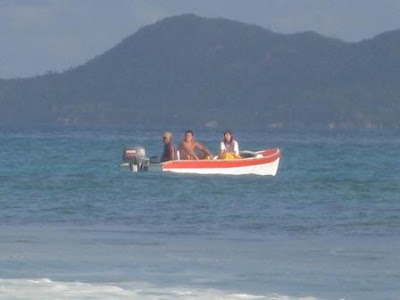
We set off in the small fibreglass with the 25hp engine, we just got to the east of the island and there, 20ft from the cliffs was an octopus boat (that’s not a boat shaped like an octopus or a boat driven by an octopus, it’s a boat with people catching octopuses). It should have been 200m off our shore, but what’s a couple of hundred meters between friends. So me and Sal confidently take our boat close to theirs and say, in a friendly manner you’re much too close. Well, the 2 people in the boat said “huh” looked away from us and carried on fishing and the chap in the water chucked another couple of octopuses in their boat. Sal, in sensed by their lack of respect for the warden of Aride said “right” got out her camera and took their photo. Bad move. I was amazed at how quick belligerence can turn to aggression.

The one who looked in charged started shouting (in Creole) and I’m now slightly worried. They pull the other chap into the boat and come towards us, luckily I never switched off the engine and I kept our distance, the shouting man was really shouting now and getting closer. If they get to close and throw their anchor into our boat we’re knackered. Now we’re starting to shit ourselves. So as always the discretion and valour old bollocks comes into play and we leg it!

They gave chase. Both boats had 25hp engines but we were lighter, 2 of us to 3 of them and a ton of octopuses so they couldn’t make up any ground on us, it was who had the most fuel or determination. We kept circling the island with them 500m behind, luckily the rangers saw that was happening and launched our tornado with 5 staff. They stopped, and we used the tornado as a shield and let the shouting man catch us up, he was not a happy bunny, as we pirouetted around the tornado he was shouting his head off and our rangers were desperately trying to calm him down. After quite some time he either got a sore throat or got fed up and just left.
Well, I thought I did bloody well to keep the distance between the two of us, with them weaned on the water and me all of 3hrs experience, I still got a smack on the head for letting them “get to bloody close”.
This was a few months ago, and I’ve seen shouting man several times fishing legitimately since then, I always get the same reaction form him, arm out straight finger pointing and the shouting “hulla bulla hulla bulla” of course it’s not hulla bulla but that’s what it sounds like. I’ve never bothered to get it translated, because I know it’s bound to be about my parentage and what he’s going to do to certain parts of my body.
Last week on a shopping trip to Praslin we came out of a shop and there was shouting man across the other side of the track. I quickly went through all the permutations in my head, i.e. should we turn around and pretend not to have seen him, buy him a beer, smack him over the head with the shopping bag. I thought no you b_____d your going to talk to me! so I put on my friendliest smile, walked over to him, put my face right in his, stuck out my hand and said “how’s the fishing buddy”. I defiantly caught him off guard, what could he do, I had the big smile and the hand out stretched so he had to take it, he did, and said “yaa fishing gud” He seemed to find it all very amusing( to my relief ) and after he shook hands with me and Sal, he left, phew.
When I see shouting man next time fishing, if he still is shouting man, my tactic will be to moon at him, or perhaps we’ve pushed are luck too far with him already, we’ll see.

One lump or two?

After working with the school children before we came out and their main concern being me having to live without chocolate whilst I was away, together with all the stories we were told before we came out here; I can remember thinking as we prepared to leave, I wonder where we will get sugar from in our diet, no more chocolate or sugary drinks. Trish the Ham Wall Administrator and I talked about this during one of our tea breaks as we each devoured a Danish pastry, and we decided that it would be from natural sugars – from fruit etc, hmmm, at the time I remember thinking that won’t be very exciting...


Over the last 8 months we have both noticed that due to our change of diet, we don’t get sugar as we suspected, we don’t eat processed food or sauces, or bought biscuits or snacks – as most of the time there aren’t any in the shops, or we don’t get to the shops to buy them. As well as this, the big source of sugar we used to have was in alcohol and now we are down to one bottle of beer a night that has dried up too. Well there are the natural sources of sugar, but they aren’t very exciting and we have found that we crave for sweet things, having never been pudding people before we now crave for cake and custard!
When we first got here we did buy biscuits when they were available, but going back to one of my earlier entries, they were never what they said they would be, pineapple crunch biscuits would taste like wet cardboard and imitation bourbon creams would be cardboard – they were atrocious.
Well I am glad this effected Melv more than it did me – the reduction of alcohol made him, loose weight dramatically, but not only that, it has inspired him to start making cakes!
Anyone who knows us will know that Melv is the cook in the partnership, and Sal is only allowed in the kitchen to clear up. Sal cooked Melv a meal shortly after they first got together 13 years ago, and it was so good he has never let her cook again!!
First started by one of the volunteers here, Melv has progressed from biscuits to muesli bars to pineapple upside down cake and they are all fabulous.

One of the latest inventions are coconut mountains, which are dependent on jam being available, but are now well known even in the Mahe office and have been a welcome addition to a cup of tea for many a visitor to Aride.

So much for thinking I was going to lose weight whilst I was here...
Ps – I’ll get Melv to write up the recipe.

Poaching

The Seychelles is no different than most places around the world wildlife wise; it’s knackered; basically where there’s people there’s no wildlife, similar sad familiar story we know so well from the UK. The reason it’s gone of course is us, with our rats, cats, chemicals and chainsaws, again just like home. Where it differs from the UK is that the Seychellois eat everything! With the excuse of tradition they eat the birds, birds’ eggs and if they miss the eggs the first time round they come back and eat the young. So with no birds left on inhabited islands, to serve tradition they come and poach on our nature reserve. The main bird they are after is the sooty tern, which arrives in it’s thousands during May to Aride to breed, they cover the higher areas of the island in dense colonies. Of course we were aware of this problem before we arrived, but we were pleasantly surprised by the outgoing warden who told us “don’t worry about it it’s not much of a problem”. Well we still don’t know to this day why he said that as we later found out he couldn’t have been further away from telling the truth if he’d tried. A few weeks later the good Seychellois staff told us a much different story, they said “it’s a commercial operation here”. So we decided to spend as much time as needed to assess the problem for ourselves.
The poachers are more active during dark, but not exclusively, so we set up watches on the beach from dawn till dusk to look for boats with more than 2 people in them (normally only 1-2 people fish in a boat) and at dusk we went in pairs to the colonies on the hill. The intention was firstly to deter the poachers by letting them know we could see them, then ring in their details to the only good bloke here re anti poaching, he would then contact the police (they deserve a blog entry all to themselves, but not while I’m still here!) so they could catch them as they got back to the mainland. Armed with a massively powerful torch and a machete, me and Sal took our first shift on the hill, at 140m high the cliff where we watched the sea - it is just stunning, sat here with 1000s of sooty terns flying right above our heads the noise was indescribable.


As the sun set the first poachers arrived, as they came to land I shone the torch at them, the torch was telling them you’ve been seen and you will get in trouble if you land, what they said to the torch was f—k you and landed anyway. These are serious people who can’t be messed with, so we legged it, with only one escape route we left in quite a hurry because of the real risk they would get around the back of us and cut us off. With the other observation points faring no better, the total amount of poachers on the island on that first night was 9 confirmed, with the certainty there where a lot more unseen. The next night we did the same, in the same place, this time, no birds no eggs just a few they had broken and no noise, all gone! What they do is strip an area clean, load the eggs into containers, so not to break the eggs they pack the containers with dead sooty terns, and if it’s just eggs they want, they break them into jerry cans so they can sell it by the litre. Well as you can imagine we were shocked and piss off, and any of you reading this who knows us will know we wouldn’t be quiet. We rang the good chap every night with what ever details we could get re boats and it’s occupants, but no arrests, which we were not at all surprised about, as we rang in more and more instances of poaching, the good chap (who has a lot of clout here) said it was getting to dangerous for us to deal with by ourselves, he was going to send in the armed police. Just to fill you in a bit, the armed police in the Seychelles, like their jobs and they shoot people.

Our CEO (Sal’s line manager), rang the director of police and asked what they intended to do, and she was told “ if there’s people on the island that shouldn’t be, they will be shot!” Shit! that sent us into a panic, don’t get me wrong, I would like all the b_____ds shot and wouldn’t lose one moments sleep no matter how many they killed. But the reality if that were to happen, would be an unthinkable back lash from the relatives and friends of the shot poachers, we, that’s all the staff would not be safe anywhere either on or off the island. Thankfully, strangely, because all Seychellois eat wild birds and eggs the chief of police thought it would be too contentious an operation with political ramifications and put a stop to it.
At the end of the poaching season 65% of our sooty terns’ eggs were taken, with that and a month of 15hr a day 7 day a week fatigue, put me into my first big sulk here, I could have caught the next flight home and said f—k it. Thankfully it only lasted a week or so.