Even after being here since Dec ‘07, over 16 months now, the wildlife still amazes me. I still firmly believe that there can’t be many places on earth as rich in wildlife as here on Aride, it truly is alive. It carries on in its own world, regardless of what we are doing, electricity or not, the sooty terns still circle nosily above the hill as they come into breed and the magpie robins still sing their beautiful song after a shower of rain.

Even after all this time, I am in awe that I live in such a place, where turtles make their way up the beach during the day and where thousands of seabirds will soon be congregating to breed. Everywhere you look there is movement, whether it is the scurrying of skinks or the fluttering of fairy terns, from dawn to dusk and through the night the wildlife does its stuff.
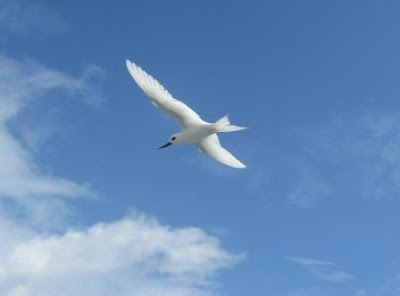 Every so often this hits home and today as I showed a group of the local school children round, it reminded me what a special place Aride is. We are just so spoilt, the young people were able to stand no more than a metre from white tailed tropic birds, fairy terns, clear the ground for magpie robins to feed in front of them and watch geckos protect their eggs on our spectacular Banyan tree. Aride inspires many people, adults and children alike and I still feel privileged that part of my job is to facilitate this, to open up this wonderful island for visitors, to let them too enjoy the wealth of wildlife it supports.

Wildlife is great, and that phrase the RSPB use ‘Aren’t Birds Brilliant’, yes they are, we have tropic birds that think they are magpie robins,

fluffy fairy terns that are so tiny I never know how they manage to hang on to the most knobbly branches,

Audubon shearwater chicks snuggled in their burrows on the side of the path

and then there are hermit crabs that are so orange they look like they’ve been painted.

There are eagle rays the size of blankets surfing the waves and fish so colourful they look like they belong in an aquarium.
As I sit and write this, the sooty terns are here in their thousands, as they begin to come in to nest, they look like a swarm of mosquitoes as they circle above the hill chattering to each other, a family of Seychelles warblers feed in the vegetation by the side of me,

and sunbirds flit backwards and forwards through the veranda, the brown noddys croak like crows in the Casuerina tree whilst the sea roars in the back ground, and there is the shrill sound of our youngest magpie robin alarm calling as it gets dark. The crabs start to collect around my feet as they seek to scavenge on any scraps that we may have thrown out through the day and it will be shortly be time for the shearwaters to start hurtling past as they make their way out to sea and of course our friendly gecko will soon be on the alert just in case there is chocolate cake on the menu tonight.


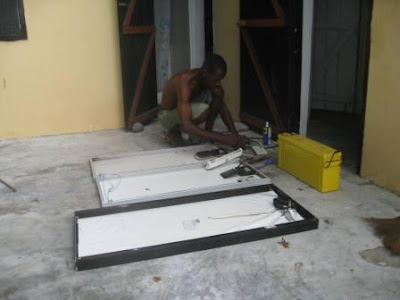 However it is quite apparent that Europeans find it rather more exciting using candles and torches, it can become a way of life, than the locals. We had a new ranger from Mahe start last week and it isn’t the best introduction to life here; no running water which you can kinda cope with, but no electric, no fridge, just a communal freezer that is kept chilled and the smelly water that runs out of the bottom of it. But worst of all seems to be the island recently acquired a TV which was very popular with rangers and volunteers, but now sits in the corner teasing – and there is a now a lot of hope resting on one of our rangers, Brian, who in a previous life was an electrician, as he now does his best to harness the energy from the sun for power.


 As for washing up in the dark, I have given up and the resident crabs deal with most of the leftovers on the plates and pans until the morning.
 But the one thing that no freezer and inefficient fridges mean we have the perfect excuse to go out fishing everyday and today brought in a Dorado – my what a whopper!!

 The underwater world is a fascinating one, full of strange creatures, spiny, spongy, colourful and bizarre. The water is so clear it was wonderful to see the regenerating coral,
 to see creatures like sting rays the size of blankets, barracudas over a metre long and to swim with turtles and brightly coloured fish . I learnt how to roll out of the boat backwards, fins and all, just like on the films, how to buddy breathe, to use my lungs like floats; breathing out to take me to the bottom and breathing in to inflate and make me float, and how to sit suspended in the water just off the sea bed. However this is certainly the climate to learn in, no need to wee in your wetsuit here to keep it warm!
 The end of financial year revealed that we have had the best year for visitors for the last 12 years with over 2050 paying guests coming ashore. Shop sales were the best ever, with over 76,000 rupees raised in the March alone which covers our monthly wage bill 3 times over, equivalent to £3,300, working out as an average spend of £10 per visitor, modest but not bad for a shop the size of ours!


 The breeding season is on its way, with over 45,000 noisy sooty terns having already arrived and punching pigeons, a strange past time of the Madagascar turtle doves use their wings to take punches at each other, as part of establishing their territories. We must enjoy the calm seas while they last, as with the breeding season comes the onset of the south east monsoon with rough seas and driving salt spray – yet another extreme.


