Saturday, 25 April 2009

We are breaking records even without mod cons.

This month already we have greeted more visitors on the shores of Aride than has ever been done since the island became open to visitors as a nature reserve in 1978.
Already with still 5 working days to go during April we have had 509 paying guests to the island and including non paying visitors this rises up to over 560. Now this may not sound a lot but when the average years total visitor figures are in the region of 2,000, this means we have already achieved a quarter of this figure in month 1. The only month that has ever come close to this was 489 paying guests in Feb 2004, apart from this the average for this time of year is more in the region of the 300 mark.

So even without electricity, running water or any of those luxuries, the Aride team is doing good, there are times when the office moves with the generator and the laptop is taken to wherever it can be charged,

or we run out of day light and there is still work to be done.


All in all this increase in figures is against all odds, the economy here in Seychelles is suffering like the rest of the world and there was a predicted 30% decline in tourism and then there are the pirates, that are currently operating in Seychelles waters. So far 3 boats have been hijacked and 10 Seychellois have been taken hostage and apparently they are only 2 hours away from here – if you believe what the papers say – won’t find much here though – have already banked the month’s money!!
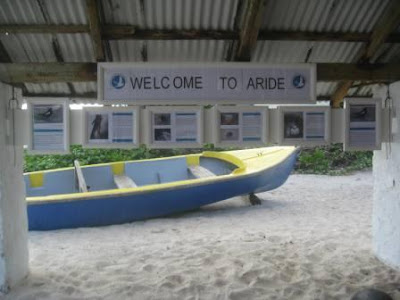
We are hoping that this success is the results of the hard work we have been putting in to marketing and improving the visitor experience. With limited resources we have installed new displays in the boatshed, tarted up the shop

and generally become far more professional in the way we greet our guests, we are flexible in our opening times and welcome all shapes and sizes of boats, and it seems as though it is paying off.

Now before you get concerned that island life is getting to me and that I am craving for human company and need to be amongst large numbers of people, don’t worry I haven’t changed – still as antisocial as ever. The significance of more visitors is literally more money to spend, all the money we raise goes straight back into the island, whether it is spent on employing more staff or buying a new boat – so at the start of the financial year this will put our Chairman (who is an accountant) in a very good mood!

Saturday, 18 April 2009

The Wildlife is still Wonderful

Even after being here since Dec ‘07, over 16 months now, the wildlife still amazes me. I still firmly believe that there can’t be many places on earth as rich in wildlife as here on Aride, it truly is alive. It carries on in its own world, regardless of what we are doing, electricity or not, the sooty terns still circle nosily above the hill as they come into breed and the magpie robins still sing their beautiful song after a shower of rain.


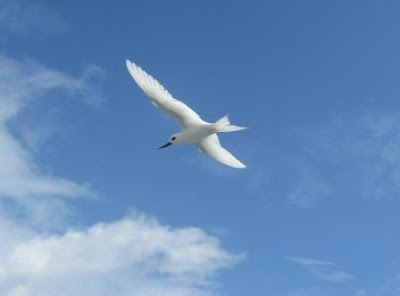
Even after all this time, I am in awe that I live in such a place, where turtles make their way up the beach during the day and where thousands of seabirds will soon be congregating to breed. Everywhere you look there is movement, whether it is the scurrying of skinks or the fluttering of fairy terns, from dawn to dusk and through the night the wildlife does its stuff.

Every so often this hits home and today as I showed a group of the local school children round, it reminded me what a special place Aride is. We are just so spoilt, the young people were able to stand no more than a metre from white tailed tropic birds, fairy terns, clear the ground for magpie robins to feed in front of them and watch geckos protect their eggs on our spectacular Banyan tree. Aride inspires many people, adults and children alike and I still feel privileged that part of my job is to facilitate this, to open up this wonderful island for visitors, to let them too enjoy the wealth of wildlife it supports.
Wildlife is great, and that phrase the RSPB use ‘Aren’t Birds Brilliant’, yes they are, we have tropic birds that think they are magpie robins,


fluffy fairy terns that are so tiny I never know how they manage to hang on to the most knobbly branches,

Audubon shearwater chicks snuggled in their burrows on the side of the path

and then there are hermit crabs that are so orange they look like they’ve been painted.


There are eagle rays the size of blankets surfing the waves and fish so colourful they look like they belong in an aquarium.

As I sit and write this, the sooty terns are here in their thousands, as they begin to come in to nest, they look like a swarm of mosquitoes as they circle above the hill chattering to each other, a family of Seychelles warblers feed in the vegetation by the side of me,


and sunbirds flit backwards and forwards through the veranda, the brown noddys croak like crows in the Casuerina tree whilst the sea roars in the back ground, and there is the shrill sound of our youngest magpie robin alarm calling as it gets dark. The crabs start to collect around my feet as they seek to scavenge on any scraps that we may have thrown out through the day and it will be shortly be time for the shearwaters to start hurtling past as they make their way out to sea and of course our friendly gecko will soon be on the alert just in case there is chocolate cake on the menu tonight.

Thursday, 9 April 2009

Life Without Electricity

So it has been exactly a week now that the island has been without electricity and if I’m honest I think it will be the first of many, knowing how long things take in Seychelles. Back in the UK, having no electric was usually for a few hours or at worse 24, may be possibly 48 when your mum and dad used to say don’t open the fridge for too long or lift the freezer lid, but then we always knew that as if by magic the electricity company would get it sorted and with a flick of a switch normality would be resumed. It was always kinda exciting when you were allowed to have a candle to read a book by in the absence of the television and you could pretend that you lived in a time when there was no electricity, like in some of the dramas on the TV. But when there is no magical electricity company that flicks a switch and normality returns, the story is a little different:
The main added complication we have is the climate, where the sun shines so intense that the sand is just too hot to walk on and the humidity makes all the envelopes stick together without licking them. This means the main major difficulty we now have is keeping food, with inefficient fridges and freezers that let ants in once the temperature raises a few degrees; it is a constant battle to stop either food being eaten or going mouldy and smelly.


There are now distinctive dead smells around our house, where the communal freezer lives, of gone off food and dirty water, which runs out of the back of the freezer as it defrosts. The operation of the small portable generator on and off throughout the day does not stop the residue water from coming out of the bottom that sticks of rotten fish. This putrid liquid oozes out onto the floor in the back office and has been successfully attracting an array of flies and insects and doesn’t smell good in 36°C!!


But having had a moan and said all this I really don’t mind, we generally wake up when it is light and go to bed when it is dark, any dark evening is currently lit up by the full moon which lights the whole island and silhouettes the bats and birds, the palm leaves shine and the beach glows – it is beautiful, especially now with no light pollution from the island at all.

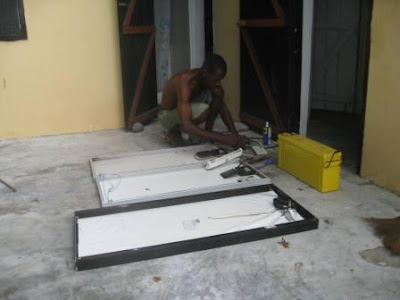
However it is quite apparent that Europeans find it rather more exciting using candles and torches, it can become a way of life, than the locals. We had a new ranger from Mahe start last week and it isn’t the best introduction to life here; no running water which you can kinda cope with, but no electric, no fridge, just a communal freezer that is kept chilled and the smelly water that runs out of the bottom of it. But worst of all seems to be the island recently acquired a TV which was very popular with rangers and volunteers, but now sits in the corner teasing – and there is a now a lot of hope resting on one of our rangers, Brian, who in a previous life was an electrician, as he now does his best to harness the energy from the sun for power.


I’m sure Brian will find a way; we have got what often feels like an endless supply of sun to provide solar power with hardly a cloud in the sky most days, which we already use to charge up batteries and phones easily.


Cooking can be a bit of a challenge though and if not achieved before the sun goes down does often needs the assistance of a head torch, but shearwaters can regularly kamikaze into the kitchen attracted by the bright light. As for washing up in the dark, I have given up and the resident crabs deal with most of the leftovers on the plates and pans until the morning.


But the one thing that no freezer and inefficient fridges mean we have the perfect excuse to go out fishing everyday and today brought in a Dorado – my what a whopper!!


Saturday, 4 April 2009

Life of Extremes

It has been a bit of a fortnight of it, some of which I will mention, others best not to, but there is one thing that it has reinforced is that life on Aride is extreme. I finding it so amazing that for an island only 73ha in size there is a never a dull moment, how wrong I was when I thought I was coming here for the quiet life!!

A couple of weeks ago I had one of the most amazing experiences ever, I learnt to dive, to breath underwater and go down to depths of 30ms.

The underwater world is a fascinating one, full of strange creatures, spiny, spongy, colourful and bizarre. The water is so clear it was wonderful to see the regenerating coral,

to see creatures like sting rays the size of blankets, barracudas over a metre long and to swim with turtles and brightly coloured fish . I learnt how to roll out of the boat backwards, fins and all, just like on the films, how to buddy breathe, to use my lungs like floats; breathing out to take me to the bottom and breathing in to inflate and make me float, and how to sit suspended in the water just off the sea bed. However this is certainly the climate to learn in, no need to wee in your wetsuit here to keep it warm! The end of financial year revealed that we have had the best year for visitors for the last 12 years with over 2050 paying guests coming ashore. Shop sales were the best ever, with over 76,000 rupees raised in the March alone which covers our monthly wage bill 3 times over, equivalent to £3,300, working out as an average spend of £10 per visitor, modest but not bad for a shop the size of ours!

This weekend has been our first weekend off for some time, the last 3 weeks have been busy with guests, training and school groups, we were looking forward to a quiet time, the rest of the team had booked to go away to hit the bright lights of Praslin and the old ‘uns; Melv and I had a crate of beer, a bottle of rum the island to ourselves. But before this could be so Wednesday night brought with it darkness at 9pm, the lights went out, so Melv went down to the generator shed to see flames licking round the door. 8 fire extinguishers later, several buckets of water and several buckets of sand, 8 tired people had successfully extinguished the flames and although we saved the shed there won’t be electricity generated from there for many months in the future especially on Seychelles time.


So now it is back to basics, portable generators and solar power, smelly freezers and fridges as 36°C turns food in seconds, and warm beer, cooking by candle light and doing the dishes by head torch, which can result in interesting encounters with shearwaters!!

Then there are the staff; they are as changeable as the weather and little like the sea – turbulent and volatile one minute and calm and quiet the next. The breeding season is on its way, with over 45,000 noisy sooty terns having already arrived and punching pigeons, a strange past time of the Madagascar turtle doves use their wings to take punches at each other, as part of establishing their territories. We must enjoy the calm seas while they last, as with the breeding season comes the onset of the south east monsoon with rough seas and driving salt spray – yet another extreme.
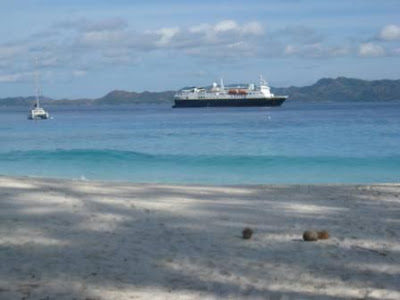
Tomorrow we have to be ready to meet and greet 80 guests off the National Geographic Explorer Cruiseship, what ever happens the life goes on and it’s business as usual.

Friday, 13 March 2009

Island to Island

The timing of my recent trip back to the UK really reinforced the sharp contrast between the two places I currently call home. February in North Wales is a shock to the system after14months in Seychelles.

There was snow and frost during my stay, but compared to some we got off lightly, as a call from a friend in Dorset reported that they had 3 inches of the cold white stuff whereas in Rhos-on-Sea at least it was confined to the tops of the mountains.

But there were some mornings were it really felt like spring, when you walk out of the door in a morning and the cold hits your face, or in an evening when you leave the warmth of a pub and a clear night makes your face tingle.


The primroses, snowdrops and blossom were beautiful, as were the garden birds; blackcaps, nuthatches, song thrush and blackbirds, very different to the magpie robin, sunbirds and Seychelles warblers I have become used to.

The lifestyle too is very different, the UK with coffee shops, full of cappuccinos, hot chocolates and rich cakes.
With pubs that sell steak pie and chips, when the gravy from the pie makes your chips soggy and stops your peas from having to be chased round the plate and of course pints of Guinness and big glasses of red wine, then there was a trip to the cinema – I haven’t done that for years!


Then there are so many types of cheese, fruit, chocolate, crisps, and vegetables, and of course family and friends full of hugs and love.


As I sit and write this, I have once more swapped the armchair and wood stove for a deck chair outside; ghost and hermit crabs wander about the sand in front of me, fairy terns cackle above me and the chorus from the sooty terns is deafening, only over powered periodically by the wail of the Audubon Shearwaters as they go hurtling by on their way out to sea – it’s pretty magic.

The moon has just risen in the nights’ sky and has lit up the island, although just past its full phase, it is still large enough to reflect on the sea looking like a strip of gold, it makes the silver sand on the beach glisten. And as I watch the fruit bats fly silhouetted in front of it, although hard to believe, it is very nice to think that this very moon is same moon that lights up your night world too.

Saturday, 24 January 2009

The Vallee De Mai – like going back in time...

Last weekend we finally after 14 months managed to get our first weekend away, although it did turn out to be more trouble than it was worth (that’s another story), the day we spent at the Vallee De Mai was amazing. It was super to be spending a few nights away from the island and on the Saturday morning it was great to be free, to wake up and feel we have got all day to ourselves, with no one else's problems to think about.

We hopped on a bus to Baie Ste Anne, as the bus winds its way right through the Vallee and down to the coast at the other side. We had taken this route many times before, but never had we had the chance to get off and explore. The entrance for the Vallee De Mai is about half the distance from Grand Anse to Baie Ste Anne, and it only took 10 minutes before we got off the bus and stepped out in the scorching sun surrounded by lush green vegetation. Once the rattle of the aged bus had left we heard an unusual call neither of us were familiar with, as we looked up we saw black parrots flying over our heads. Quite large about the size of a crow, they were squawking as they flew around the tops of the trees and palms - this only increased my excitement to see this place, the lush green tropical vegetation beckoning us forward.

The Vallee de Mai is a palm forest and a remnant of when Seychelles' granitic islands were still part of Gondwanaland, the huge land mass which included what is now Africa, Madagascar and India. Millions of years of isolation enabled a unique community of plants and animals to develop and now some species can be found nowhere else. Up to the 1930s the Vallee De Mai remained as a virgin forest and was little affected by man, however a new land owner decided to beautify the valley and decided to introduce a variety of ornamental trees and fruit trees. But in 1948 the area was acquired by the Government as a major water catchment area fort the island of Praslin and rehabilitation became a priority and in 1966 it became a nature reserve. The rehabilitation involved the gradual removal of the exotic and invasive species and already today after a short time, the Vallee is starting to take on its primeval appearance once again.

The reserve is most important for its coco de mer palm surrounded by myth s and legends this palm has male and female palms, the female produces the largest seed in the world and it can weigh more than 20kg and takes between 6 and 7 years to ripen. Growing up to 30m for the male and 24 m for the female these palms are thought to be able to live for between 200 and 400 years. These coco de mer palms grow naturally on only two small islands in the whole world, here at the Vallee De Mai, Praslin and on the island of Curieuse 2 nautical miles north of Praslin.

We were in for treat, as we walked up the entrance path the tropical forest got thicker and before long we were under cover of the huge palms and lush green vegetation. The wind blew and the sound of the palms crashing together was like something we have never heard before, the coco de mer palm has no trunk, just the long leaves coming from its base and their movement in the wind rattled the leaves together. They towered above us and we were completely enclosed by them, with no sky to be seen, we could hear rain, but didn't feel a drop. The bird noise of black parrots and bulbuls completed the experience, we could've been in an extensive tropical forest miles from anywhere, rather than a remnant on Praslin, as I stood and looked I tried to imagine that this is what it would've been like, and that some of these plants would've been on Aride too.

We walked up to the view point and there we were welcomed by a bulbul, a beautiful bird, obviously he had been fed at this point before, he was curious and tried to investigate my bag.
He hoped along the bench to where we were sitting and sat and watched, bright orange beak and feet with lovely spiky black crown, and iridescent green back and wings.
The view point gave height to look over the mass of green tropical vegetation, the sun brought out all the different shades and colours, the black parrots flew across in front of us calling and we had the place to ourselves, there was no other sound than the natural sounds, the wind blowing through the palms and the birds calling out from the shelter of the forest - a very beautiful place, like going back in time.

Saturday, 10 January 2009

Fancy a bit of chocolate cake?

First it’s turtles round for breakfast and then it’s geckos round for tea!


This was the first time we had seen this, although skinks are regular visitors to the kitchen, especially when a cake has just been made, geckos usually stick to flies and cockroaches – but not this one we caught it after the chocolate cake - cheeky!


Geckos are amazing creatures; the sticky pads on their feet mean that they can go anywhere, clinging to vertical surfaces is no problem, ideal for climbing up kitchen cupboards.
We have got two sorts on Aride, this one, which is the bronze-eyed gecko, which are extremely variable in colour, the one who has found our kitchen is one of the best marked individuals I’ve seen, and its stripes look like the pile of a carpet. Then there is the green day gecko, which is not seen as frequently, but is a wonderful bright green.


Over here cake is very precious and much sort after, with our diet severely lacking sugary things, so we moved it out of geckos’ way and replaced it with a few spare crumbs and it immediately found those as well!
Since then he has become a regular visitor and ‘Art’ can often be seen peeping round the window with those big bulging eyes.